Exclusive Right to Sell vs. Exclusive Agency: Which Real Estate Agreement is Right for You?
Selling a home is one of the most significant financial transactions you will ever undertake. While most people focus on staging, pricing, and marketing, the foundation of a successful sale often lies in the fine print of the paperwork signed before the “For Sale” sign even goes up. Specifically, the type of listing agreement you choose can drastically alter your relationship with your real estate agent, your financial obligations, and the overall control you maintain over the selling process.
Two of the most common yet frequently confused real estate agreements are the Exclusive Right to Sell and Exclusive Agency listings. At a glance, they might sound identical—after all, they both include the word “exclusive.” However, the difference between these real estate listing types can mean the difference between paying a hefty commission or paying nothing at all if you find your own buyer.
If you are a homeowner preparing to sell or a new agent looking to better explain these concepts to clients, understanding the nuances of these contracts is crucial. In this comprehensive guide, we will break down the “exclusive right to sell vs exclusive agency” debate, explore the pros and cons of each, and help you decide which path aligns best with your selling goals.
What Are Real Estate Listing Agreements?
Before diving into the specific differences, it is helpful to understand what a listing agreement actually does. A listing agreement is a legally binding contract between a property owner and a real estate broker. This document authorizes the broker to represent the seller and market the property to potential buyers.
These agreements outline several key terms:
- Duration: How long the agent has to sell the home.
- List Price: The initial asking price for the property.
- Duties: What the agent will do to market the home (MLS listing, open houses, etc.).
- Real Estate Commission: How much the agent will be paid upon a successful sale.
While the goal is always to sell the property, how the agent gets paid and who is allowed to find the buyer varies significantly depending on whether you sign an exclusive right to sell or an exclusive agency agreement.
Deep Dive: What is an Exclusive Right to Sell Agreement?
The Exclusive Right to Sell is the gold standard in the real estate industry. It is the most common agreement used by realtors and brokerages across the United States.
How It Works
In an exclusive right to sell agreement, you grant one specific broker the sole right to list, market, and sell your property. The defining feature of this contract is the commission structure. Under this agreement, the listing broker is entitled to a commission regardless of who finds the buyer.
It does not matter if the buyer is found through the MLS, an open house, a social media ad, or even if your neighbor walks over and offers to buy the house directly from you. If the house sells during the contract period, the agent gets paid.
Why Agents Prefer This
Real estate agents heavily favor this type of agreement because it guarantees them payment for their hard work. Selling a home requires an upfront investment of time and money. Agents pay for professional photography, staging advice, online marketing, and MLS fees out of their own pockets. If they risk doing all that work only for the seller to find a buyer independently and cut them out of the commission, they are less likely to invest heavily in the property.
With an exclusive right to sell, the agent knows their investment is protected, which typically motivates them to work harder to get the best price possible.
Key Characteristics
- Guaranteed Commission: The agent earns a fee no matter who brings the buyer.
- Maximum Exposure: Agents are willing to spend more on marketing.
- Full Service: Usually includes comprehensive support from listing to closing.
- Simplicity: There is no ambiguity about who “procured” the buyer.
Deep Dive: What is an Exclusive Agency Listing?
An Exclusive Agency agreement is a bit of a hybrid. It offers a middle ground between hiring a full-service agent and selling the home yourself (For Sale By Owner, or FSBO).
How It Works
Like the exclusive right to sell, an exclusive agency agreement grants one broker the right to market your property. However, there is a massive caveat regarding the real estate commission. In this arrangement, the agent only gets paid if they (or another cooperating agent) find the buyer.
If you, the seller, find a buyer entirely on your own—without the agent’s help—you do not owe the listing agent a commission. You retain the right to sell the property yourself.
The “Catch” for Agents
Because the agent runs the risk of earning zero dollars despite listing the property, many brokerages are hesitant to accept exclusive agency listings. If they do accept them, they might offer limited services. For example, they might list the home on the MLS (Multiple Listing Service) but refuse to pay for premium marketing, open houses, or professional photography.
Key Characteristics
- Conditional Commission: You only pay if the agent brings the buyer.
- Seller Flexibility: You can actively seek buyers yourself to save money.
- Risk for Agents: Agents may prioritize other listings where their pay is guaranteed.
- Potential for Disputes: It can sometimes be difficult to prove who actually “found” the buyer, leading to friction.
Exclusive Right to Sell vs Exclusive Agency: The Core Differences
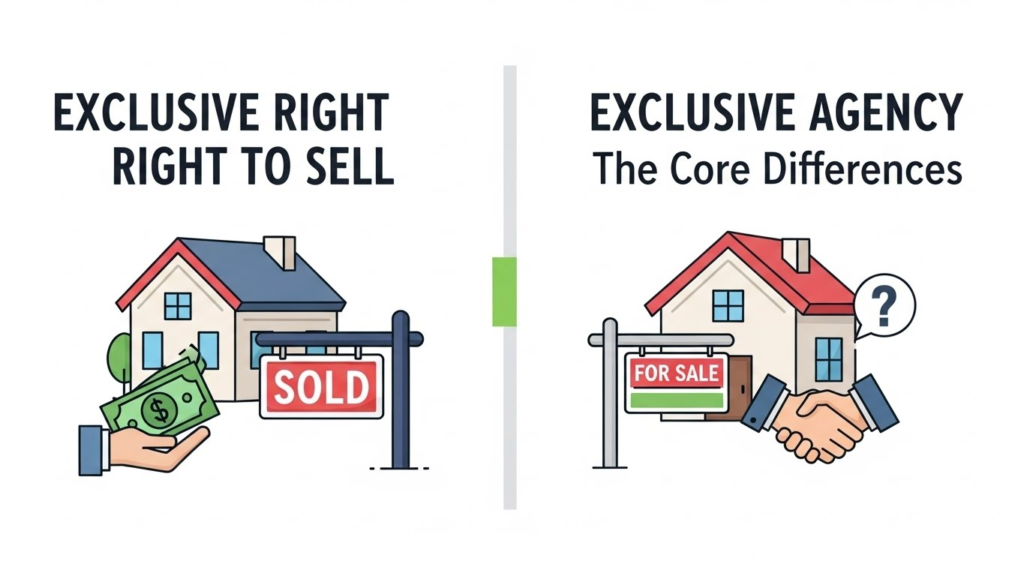
To visualize the distinction, imagine a race to find a buyer.
In an Exclusive Right to Sell scenario, the agent is the only one running the race. Even if you cross the finish line holding a buyer’s hand, the agent still gets the prize (commission) because you hired them to manage the entire event.
In an Exclusive Agency scenario, you and the agent are racing against each other. If the agent crosses the finish line with a buyer first, they get paid. If you cross the finish line with a buyer first, you keep the prize money (the commission savings).
Here is a quick comparison table to summarize:
| Feature | Exclusive Right to Sell | Exclusive Agency |
|---|---|---|
| Commission Payout | Guaranteed to the broker, regardless of who finds the buyer. | Paid to broker ONLY if they procure the buyer. No fee if seller finds buyer. |
| Agent Motivation | High. Their income is secured, so they invest heavily in marketing. | Moderate to Low. They risk working for free. |
| Marketing Efforts | Typically includes professional photos, staging, ads, and open houses. | Often limited to MLS entry and basic signage. |
| Seller Control | Low. The agent handles the entire process. | High. You can market and sell the home independently. |
| Common Use Case | Most residential sales; sellers wanting full service. | Experienced investors; sellers with a potential buyer already lined up. |
Pros and Cons of Exclusive Right to Sell
This is the industry standard for a reason, but it is not without its downsides.
Pros
- Maximum Marketing Exposure: Because the agent is guaranteed a return on investment, they will pull out all the stops. This includes syndicating your listing to thousands of websites (Zillow, Realtor.com, Redfin), hosting open houses, and networking with other local agents.
- Dedicated Representation: You get a professional negotiating on your behalf. They handle the legal paperwork, inspections, and the emotional roller coaster of the transaction.
- Faster Sales: Incentivized agents work faster. Statistically, homes listed with full-service agents tend to sell faster and often for a higher price than FSBO or limited-service listings.
- Simpler Process: You don’t have to worry about marketing or vetting buyers. You simply hand over the keys and let the professional do their job.
Cons
- Cost: You are locked into paying the real estate commission (typically 5-6% split between buyer and seller agents), even if you sell the house to your cousin.
- Less Flexibility: You cannot sell the home yourself to avoid the fee once the contract is signed.
Pros and Cons of Exclusive Agency

This agreement is attractive to those who want to save money but still want some exposure.
Pros
- Financial Savings: If you are willing to hustle and find a buyer yourself, you can save the listing side of the commission (usually 2.5% to 3% of the sale price). Note: You will likely still have to pay the buyer’s agent commission.
- MLS Access: The biggest advantage is getting your home on the MLS. This is the database all realtors use. Without an agent, you generally cannot get on the MLS. Exclusive agency gets you there without full commitment.
- Control: You can aggressively market the property on your own social media or personal network without feeling like you are stepping on your agent’s toes.
Cons
- Reduced Agent Effort: This is the biggest drawback. Agents have bills to pay. They will naturally prioritize clients who have signed exclusive right to sell agreements because that paycheck is secure. Your home might fall to the bottom of their priority list.
- Marketing Costs Fall on You: Since the agent isn’t guaranteed a commission, they likely won’t pay for professional photos or staging. You will have to organize and pay for these yourself to make the listing look good.
- Broker Stigma: Some buyer’s agents are wary of showing exclusive agency listings. They may fear that the seller (you) will try to cut them out of the deal or be difficult to negotiate with directly.
- Complicated “Procuring Cause”: Disputes can arise. If an agent holds an open house and a buyer walks in, but then that buyer contacts you directly a week later, who “found” them? These grey areas can lead to legal headaches.
When Should You Choose Exclusive Right to Sell?

For the vast majority of home sellers, the Exclusive Right to Sell is the best option. It aligns the interests of the seller and the agent. You want the highest price in the shortest time; the agent wants the highest commission in the shortest time.
Choose this agreement if:
- You value convenience: You have a job, a family, and a life. You don’t have time to field phone calls, schedule showings, and vet potential buyers.
- You want the highest price: Full-service agents are skilled at creating bidding wars and marketing strategies that drive up the sale price, often offsetting the cost of the commission.
- You are inexperienced: If you don’t know the legal ins and outs of real estate contracts, disclosures, and closing procedures, you need a professional to guide the ship.
- You are in a buyer’s market: When homes are hard to sell, you need an agent who is 100% committed to moving your property.
When Should You Choose Exclusive Agency?
While less common, the Exclusive Agency agreement has its place in the market. It is essentially a safety net for FSBO sellers.
Choose this agreement if:
- You have a buyer in mind: Maybe you have a tenant who says they want to buy, or a neighbor who is interested. You can sign an exclusive agency agreement to get MLS exposure for backup, but reserve the right to sell to your interested party commission-free.
- You are an experienced investor: If you buy and sell homes for a living, you likely know the paperwork and the market well enough to handle the buyer search yourself, but you still need MLS access.
- You are in a blazing hot seller’s market: If homes in your neighborhood are selling in 24 hours with multiple offers, you might feel confident you can find a buyer without full agent support.
- You are on a tight budget: If you have zero equity and cannot afford the full commission, this might be a necessary financial decision.
The Role of Real Estate Commission
Understanding how commission works is central to this debate. In a standard real estate transaction, the total commission (often 5-6%) is split four ways:
- Listing Broker
- Listing Agent
- Buyer’s Broker
- Buyer’s Agent
In an Exclusive Right to Sell: The seller pays the full agreed-upon percentage. The listing brokerage takes its share and shares the rest with the buyer’s brokerage.
In an Exclusive Agency:
- If the Agent finds the buyer: The seller pays the full commission split as described above.
- If the Seller finds the buyer: The seller pays nothing to the listing broker. However, if the buyer has an agent, the seller usually still pays the buyer’s agent commission (typically 2.5-3%). You generally only save the listing side of the fee.
Important Clauses to Watch For
Regardless of which real estate agreements you choose, always read the fine print. Look for these specific clauses:
1. Protection Period (or Safety Clause)
This clause states that if you fire your agent or the contract expires, and then you sell the home shortly after to someone the agent introduced to the property, you still owe them a commission. This prevents sellers from waiting out the contract to cut the agent out of the deal.
2. Cancellation Policy
Life happens. You might decide not to sell, or you might realize you and your agent are a bad fit. Check the termination terms. Exclusive right to sell agreements are harder to cancel than exclusive agency agreements, often requiring a fee to cover the agent’s marketing costs.
3. Exclusions
Even in an exclusive right to sell agreement, you can negotiate “exclusions.” If you have a specific person interested in your home (like a family member), you can write their name into the contract. If that specific person buys the house, no commission is due. This is a great way to get the security of an exclusive right to sell while keeping a door open for a private deal.
How to Negotiate the Right Agreement
Real estate is a relationship business, and everything is negotiable. If you are torn between the two options, have an honest conversation with your potential agent.
- Ask about flexibility: Some agents might agree to a “variable commission” rate. For example, they might charge 6% if another agent brings the buyer, but only 4% if they find the buyer themselves (since they don’t have to split it).
- Request a trial run: In rare cases, an agent might agree to a short-term exclusive agency agreement (e.g., 30 days) to let you try to sell it yourself, with the condition that it converts to an exclusive right to sell if you fail to find a buyer.
- Discuss marketing expectations: If you choose exclusive agency, ask specifically what will NOT be included. Will you get a lockbox? Will they handle scheduling? Knowing the service gaps upfront prevents disappointment later.
Potential Pitfalls of Exclusive Agency for Sellers
While saving 3% sounds fantastic, the reality of exclusive agency listings is often more complex. Here are the risks you must be prepared for:
The “Steering” Problem
While illegal and unethical, “steering” can happen. Buyer’s agents want to show homes where the transaction will be smooth. If they see an exclusive agency listing, they know they might be dealing directly with a seller rather than a fellow professional. This can make the transaction harder, so some agents might unconsciously (or consciously) avoid showing your home.
The Negotiation Disadvantage
When you find your own buyer, you are representing yourself. If the buyer has an aggressive agent, you are an amateur going up against a pro. You might save on commission but lose money on the final sale price or concessions because you were out-negotiated.
Time Commitment
Finding a buyer isn’t just about posting on Facebook. It involves answering calls at all hours, arranging showings, ensuring potential buyers are pre-approved, and hosting open houses. If you work full-time, this can quickly become a second job.
The Bottom Line: Which is Best?
The debate of exclusive right to sell vs exclusive agency ultimately comes down to your priorities: Security vs. Savings.
If you want the highest likelihood of a sale, the least amount of stress, and professional guidance through a litigious and complex process, the Exclusive Right to Sell is the clear winner. It creates a partnership where both you and your agent are fully committed to the same goal.
If you are an experienced seller with a strong network, plenty of time, and a high tolerance for risk, an Exclusive Agency agreement offers a way to leverage the MLS while retaining the chance to save money.
Before signing, assess your local market conditions, your personal experience with real estate, and your financial flexibility. Whichever you choose, ensure the terms are clear, the communication is open, and the goal remains the same: getting to the closing table successfully.