Cost of Asphalt vs Concrete: The Ultimate Guide
When planning a new driveway, road, or parking lot, one of the first major decisions you’ll face is the choice of material. For most property owners, this boils down to a classic debate: asphalt or concrete? Both are durable, reliable paving solutions, but they come with distinct differences in cost, maintenance, longevity, and appearance. Understanding these differences is key to making an informed decision that fits your budget, climate, and long-term goals.
This comprehensive guide will break down the cost of asphalt vs concrete, exploring every factor from initial installation to lifetime maintenance. We will provide a detailed asphalt vs concrete cost comparison, examine the pros and cons of each material, and help you determine which option is the superior choice for your specific project. By the end, you will have a clear picture of the true investment required for both paving materials.
The Upfront Cost of Asphalt vs Concrete
The initial installation cost is often the most significant factor for many homeowners and project managers. Generally, asphalt has a lower upfront cost than concrete, making it an attractive option for those with a tighter budget or larger areas to pave.
Asphalt Installation Costs
As a petroleum-based product, the price of asphalt (also known as blacktop) is closely tied to fluctuations in crude oil prices. However, it consistently remains the more affordable option for initial installation.
On average, an asphalt driveway costs between $3 and $7 per square foot installed. For a typical two-car driveway of about 600 square feet, you could expect to pay anywhere from $1,800 to $4,200.
Several factors influence this cost:
- Project Size: Larger projects may have a lower cost per square foot due to economies of scale, but the overall project cost will be higher.
- Site Preparation: If your project requires significant grading, excavation, or the removal of an old surface, your costs will increase.
- Asphalt Thickness: Standard driveways typically require a compacted thickness of 2 to 3 inches. Thicker layers for heavy-duty use will cost more.
- Labor Rates: Local labor costs vary significantly by region and can impact the final price.
Concrete Installation Costs
Concrete, a mixture of cement, sand, gravel, and water, typically has a higher upfront installation cost. The material itself is more expensive, and the installation process is more labor-intensive.
A standard concrete driveway costs between $4 and $8 per square foot for a basic installation. For that same 600-square-foot driveway, the cost would range from $2,400 to $4,800. This price can escalate quickly with customizations.
Factors influencing concrete costs include:
- Custom Finishes: The basic cost is for a standard broom-finished surface. Stamped patterns, colored pigments, or exposed aggregate finishes can push the cost to $15 per square foot or more.
- Reinforcement: Adding rebar or wire mesh for extra strength and crack prevention will add to the material and labor costs.
- Complexity: Curved designs or intricate shapes are more difficult to form and pour, increasing labor expenses.
- Material Strength: Higher PSI (pounds per square inch) concrete mixes designed for heavy loads are more expensive.
Upfront Cost Winner: Asphalt
When it comes to the initial investment, asphalt is the clear winner. Its lower per-square-foot cost makes it a more budget-friendly choice, especially for large-scale projects like long driveways or parking lots. However, the upfront price is only one part of the total cost of ownership.
Lifetime Costs and Maintenance: A Deeper Comparison
The long-term cost of asphalt vs concrete tells a different story. While asphalt is cheaper to install, it generally requires more frequent and consistent maintenance. Concrete, though more expensive initially, can have a lower lifetime cost due to its durability and minimal upkeep requirements.
Asphalt Maintenance and Repair Costs
Asphalt is a flexible pavement, which allows it to withstand minor ground shifts without significant cracking. However, it is also softer and more susceptible to damage from sun, water, and chemical spills.
Routine Maintenance:
- Sealcoating: To protect the surface from UV radiation, water penetration, and oxidation, asphalt driveways should be sealcoated every 3 to 5 years. The cost for professional sealcoating is typically $0.20 to $0.70 per square foot, which translates to $120 to $420 for a 600-square-foot driveway.
- Crack Filling: Small cracks should be filled as soon as they appear to prevent water from seeping underneath and causing larger problems. This is a relatively inexpensive DIY task, or it can be included in professional sealing services.
Repair Costs:
- Potholes and Alligator Cracking: More significant damage requires patching or resurfacing. Small pothole patches might cost $100 to $300, while larger areas of “alligator cracking” (interconnected cracks resembling an alligator’s skin) may necessitate a full resurfacing.
- Resurfacing (Overlay): If the foundation is still intact, an asphalt driveway can be resurfaced with a new 1.5 to 2-inch layer of asphalt. This costs significantly less than a full replacement, typically running $1 to $3 per square foot.
With proper maintenance, an asphalt driveway can last 15 to 20 years. Assuming sealcoating every 4 years and one resurfacing, the lifetime maintenance cost can add up significantly, potentially erasing the initial savings.
Concrete Maintenance and Repair Costs
Concrete is a rigid, durable material that requires very little routine maintenance. It stands up well to heat and heavy loads, but its rigidity can make it prone to cracking with ground movement or freeze-thaw cycles.
Routine Maintenance:
- Sealing: While not always required, sealing a concrete driveway every 5 to 10 years can protect it from stains and moisture, especially in harsh climates. A quality sealer costs $0.50 to $1.50 per square foot applied.
- Cleaning: Occasional pressure washing is usually all that’s needed to keep concrete looking clean.
Repair Costs:
- Crack Repair: Hairline cracks are common and often not a structural concern. Larger cracks can be filled with a concrete caulk or epoxy filler. However, color matching can be difficult, making repairs more noticeable than on asphalt.
- Slab Jacking: If a concrete slab sinks or becomes uneven, it can sometimes be lifted back into place through a process called slab jacking or mudjacking. This is cheaper than replacement, but can still cost several hundred to over a thousand dollars.
- Replacement: Unlike asphalt, concrete cannot be easily resurfaced. If the surface becomes heavily cracked or spalled (flaked), the only solution is to break up and replace the entire damaged section or slab, which is a costly and disruptive process.
A well-installed and maintained concrete driveway can last 30 to 50 years or even longer. The minimal maintenance needs mean that over its long lifespan, concrete can often be the more economical choice despite its higher upfront cost.
Lifetime Cost Winner: Concrete
For those planning to stay in their property long-term, concrete’s impressive longevity and low maintenance needs often give it the edge in lifetime cost. The initial investment is higher, but it pays off over decades of reliable service.
Asphalt vs Concrete Pros and Cons
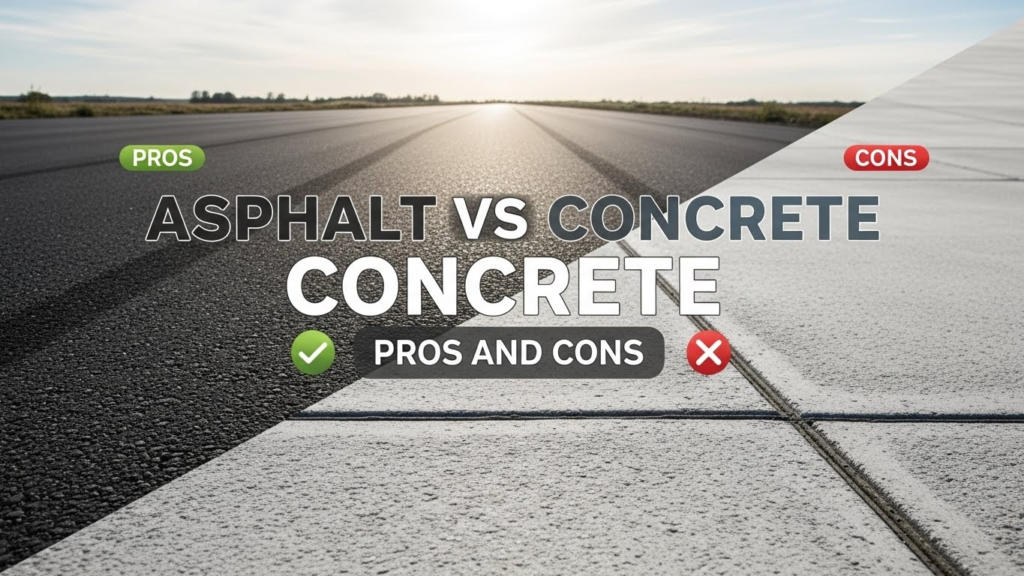
Beyond cost, each material has inherent advantages and disadvantages that might make one a better fit for your climate, usage, and aesthetic preferences.
The Pros and Cons of Asphalt
Pros:
- Lower Initial Cost: As discussed, asphalt is cheaper to install.
- Faster Installation: An asphalt driveway can often be laid in 1-2 days and is ready for use within 24-72 hours, minimizing disruption.
- Better in Cold Climates: The black color absorbs heat, helping snow and ice melt faster. Its flexibility also allows it to better handle freeze-thaw cycles without cracking as severely as concrete.
- Easier and Cheaper to Repair: Small cracks are easily filled, and the entire surface can be resurfaced for a fraction of the cost of replacement, restoring a like-new appearance.
Cons:
- Requires Regular Maintenance: Needs to be sealcoated every 3-5 years to prevent oxidation and deterioration, adding to the lifetime cost.
- Shorter Lifespan: Typically lasts 15-20 years, about half the lifespan of concrete.
- Susceptible to Heat: Can become soft and tacky in extreme summer heat. Pointed objects like kickstands or high heels can leave indentations.
- Vulnerable to Stains: Oil, gas, and chemical spills can dissolve the petroleum binders, softening the surface and leaving permanent stains if not cleaned quickly.
- Limited Design Options: Generally only available in black.
The Pros and Cons of Concrete
Pros:
- Exceptional Durability and Lifespan: Can last 30-50+ years with minimal maintenance. It has a high compressive strength, making it ideal for supporting heavy vehicles.
- Low Maintenance: Does not require regular sealcoating. Occasional cleaning is usually sufficient.
- Design Versatility: Can be customized with a wide range of colors, textures, and stamped patterns to mimic stone, brick, or other materials.
- Stays Cool: The light color reflects heat, keeping the surface cooler to the touch in hot climates.
Cons:
- Higher Initial Cost: The upfront investment is significantly more than for asphalt.
- Difficult to Repair: Repairs are often obvious and difficult to blend. Major damage usually requires costly and disruptive replacement of entire slabs.
- Prone to Cracking: While strong, concrete’s rigidity makes it susceptible to cracking from ground settling or extreme freeze-thaw cycles. Control joints are necessary to manage this, but some cracking is inevitable.
- Stains Can Be Permanent: While less susceptible to chemical damage than asphalt, oil and rust can soak into the porous surface, creating permanent stains if not cleaned immediately.
- Longer Cure Time: Concrete takes longer to cure. You may need to wait up to a week before you can drive on a new concrete surface.
Making the Right Choice for Your Project
The best choice between asphalt and concrete depends on your priorities. Let’s consider a few common scenarios.
For a Standard Residential Driveway
If your primary concern is upfront budget, asphalt is hard to beat. It provides a smooth, functional surface for a lower initial price. This is especially true in colder northern climates where asphalt’s flexibility and de-icing properties are major advantages.
If your priority is long-term value and curb appeal, concrete is the superior option. Its longevity, minimal upkeep, and vast design possibilities can increase your home’s value. In hot southern climates, its heat-reflective properties are a significant comfort and safety benefit.
For Roads and Commercial Applications
The asphalt vs concrete cost comparison for roads and large commercial lots follows a similar logic but on a much larger scale.
- Asphalt Roads: Often preferred for public roads due to the lower initial cost, faster installation (which minimizes traffic disruption), and ease of repair. Municipalities can resurface roads relatively quickly and cheaply.
- Concrete Roads: Used for high-traffic interstates and areas requiring extreme durability. While the initial cost is very high, the long lifespan and reduced need for repairs can make it more cost-effective over a 50+ year timeframe.
- Commercial Parking Lots: The decision here often comes down to the business’s capital budget versus its long-term operational budget. A new business might choose asphalt to conserve initial capital, while an established corporation might invest in concrete for its long-term durability and professional appearance.
Conclusion: Investing in Your Property’s Foundation
The “cost of asphalt vs concrete” is not just about the initial quote from a contractor. It’s a complex equation that includes installation, maintenance, repairs, lifespan, and even climate.
Asphalt offers a fast, affordable, and effective paving solution with a lower barrier to entry. It’s an excellent choice for budget-conscious projects and performs particularly well in cold climates. However, be prepared for the recurring cost and effort of regular maintenance to maximize its 15-to-20-year lifespan.
Concrete demands a higher upfront investment but rewards you with decades of durability, minimal maintenance, and enhanced curb appeal. For those seeking a long-term, “set it and forget it” solution with extensive design flexibility, concrete is an unmatched choice, especially in warmer regions.
Ultimately, the best decision comes from weighing the upfront asphalt vs concrete cost comparison against the long-term pros and cons. Evaluate your budget, your climate, and how long you plan to own the property. By doing so, you can confidently choose the material that will provide the best value and performance for your needs for years to come.