Central Air Installation Cost: Complete 2026 Pricing Guide
Summer heat arrives fast. One day you are comfortable, and the next you are sweating through your sheets, wondering if a window unit is enough to survive the season. If you are reading this, you are likely ready to upgrade to a more permanent, whole-home solution. You want to know exactly what you are getting into financially before you call a contractor.
Installing central air is a significant investment in your home’s value and your family’s comfort. However, the price tag varies wildly based on factors most homeowners don’t consider until they see the quote. From the square footage of your property to the condition of your existing ductwork, several variables dictate the final number.
This guide provides a comprehensive breakdown of central air installation costs. We will analyze HVAC system pricing, explore hidden fees, and offer actionable strategies to help you secure the best deal on your new cooling system.
The Average Cost to Install Central Air
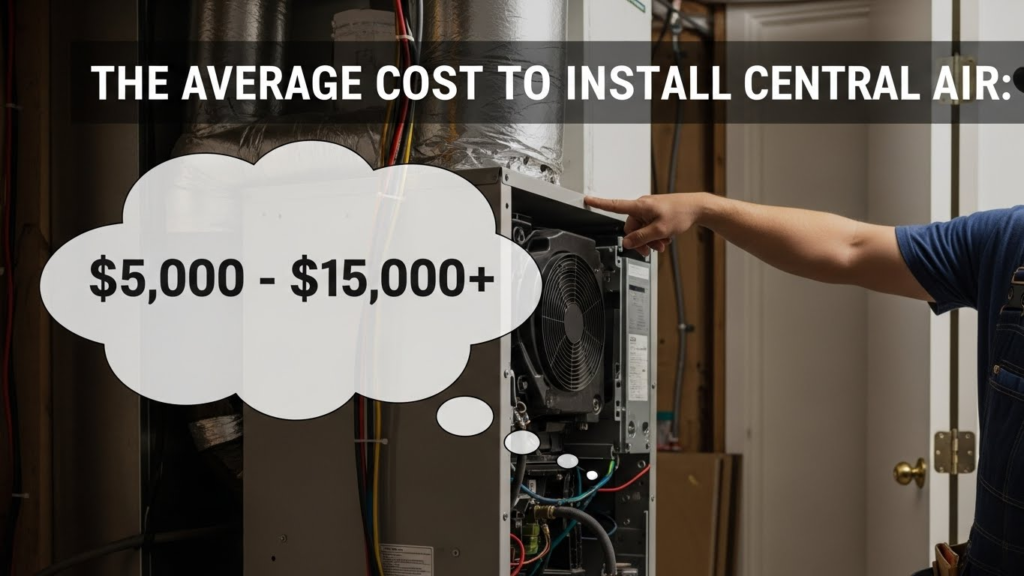
Let’s start with the numbers you are looking for. On average, most homeowners in the United States spend between $5,000 and $12,500 to install a new central air conditioning system. The national average sits right around $7,500.
However, this range assumes a straightforward replacement or a new installation in a home that is already prepped for it. If your home presents complex challenges, such as a lack of ductwork or outdated electrical panels, costs can easily climb toward $15,000 or more.
Cost Breakdown: Equipment vs. Labor
When you look at an invoice for home cooling solutions, you will typically see a split between the equipment and the labor.
- Equipment Costs (40-60%): This covers the AC unit itself (compressor and condenser), the evaporator coil, refrigerant lines, and the thermostat. A standard unit might cost between $3,000 and $6,000 depending on the brand and efficiency rating.
- Labor Costs (40-60%): HVAC installation is skilled trade work. You are paying for licensed technicians who know how to handle high-voltage electricity and dangerous refrigerants safely. Labor typically runs between $2,500 and $6,000. This often covers the removal and disposal of your old unit as well.
Cost Estimates by Home Size
One of the primary drivers of air conditioning unit cost is the size of the system required to cool your space. HVAC professionals measure this in “tons.” A ton refers to the cooling capacity of the unit (specifically, the ability to melt one ton of ice in 24 hours). Generally, you need about 20 BTUs (British Thermal Units) per square foot of living space.
If you install a unit that is too small, it will run constantly and fail to cool your home. If you install one that is too big, it will “short cycle” (turn on and off rapidly), leading to humidity issues and premature wear.
Here is a general pricing tier based on home size and required tonnage:
1,000 to 1,500 Square Feet (2 to 2.5 Tons)
- Estimated Cost: $3,500 – $7,000
- Ideal For: Small homes, condos, or townhouses.
- Units in this range are relatively compact and affordable. If you have existing ductwork, installation is usually quick.
1,500 to 2,000 Square Feet (3 to 3.5 Tons)
- Estimated Cost: $4,500 – $8,500
- Ideal For: Average sized single-family homes.
- This is the most common residential size. Pricing fluctuates heavily here based on the efficiency rating (SEER2) you choose.
2,000 to 2,500 Square Feet (4 to 5 Tons)
- Estimated Cost: $6,000 – $10,500
- Ideal For: Larger homes with open floor plans.
- At this size, energy efficiency becomes critical. A cheaper, low-efficiency unit might save money upfront but will result in massive electricity bills for a home of this size.
3,000+ Square Feet (Multiple Units)
- Estimated Cost: $10,000 – $20,000+
- Ideal For: Large estates or multi-story homes.
- Homes of this size often require two separate units (zoned cooling) to maintain consistent temperatures on different floors. This essentially doubles your equipment cost.
Crucial Factors Influencing Central Air Installation Cost
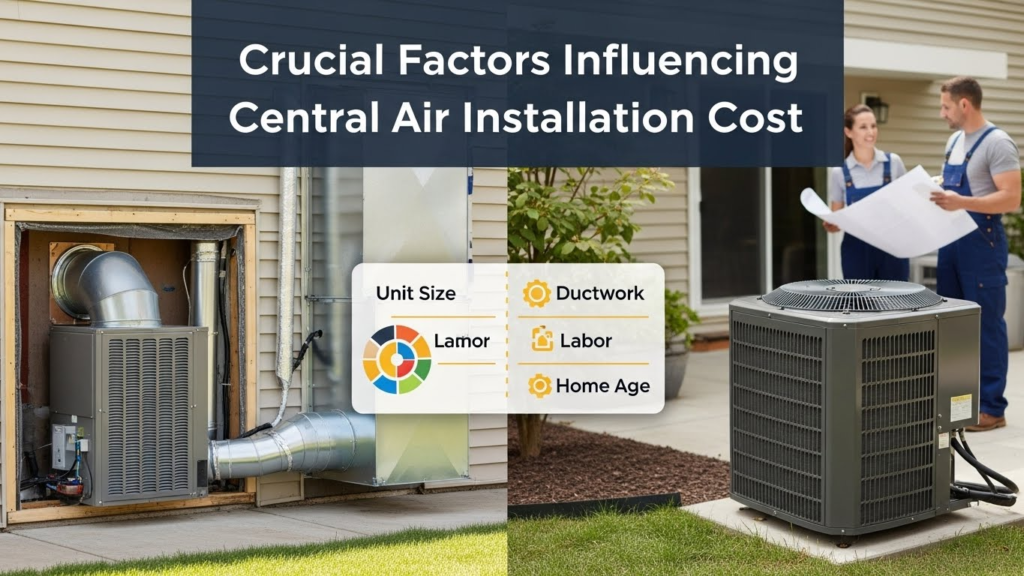
Why does your neighbor pay $6,000 while your quote comes in at $9,500 for a similar house? The devil is in the details. HVAC system pricing is rarely “one size fits all.”
1. Ductwork: The Hidden Expense
This is the single biggest variable. Central air relies on a network of ducts to distribute cool air.
- Existing Ductwork: If you are replacing an old AC or adding AC to a home with a forced-air furnace, your ducts might be ready to go. You may only need minor repairs, costing $300 to $1,000.
- No Ductwork: If you live in an older home with boiler heat (radiators) and no ducts, you face a major construction project. Installing new ductwork involves cutting into walls, ceilings, and closets. This can add $3,000 to $6,000 to your project, sometimes pushing the total over $15,000.
2. SEER2 Ratings (Energy Efficiency)
SEER stands for Seasonal Energy Efficiency Ratio. In 2023, the industry moved to SEER2, a stricter testing standard. The higher the rating, the less energy the unit uses to cool your home.
- Standard Efficiency (13.4 – 15 SEER2): Lower upfront cost, higher monthly bills. Good for mild climates.
- High Efficiency (16 – 20+ SEER2): Higher upfront cost (can add $1,500–$3,000 to the price), but lowers monthly utility bills significantly. These units often qualify for tax credits.
3. Compressor Type
The compressor is the heart of the AC unit. It dictates how the unit runs.
- Single-Stage: Runs at 100% capacity whenever it is on. It is loud and less efficient but is the cheapest option.
- Two-Stage: Can run at 100% or roughly 70%. It offers better humidity control and is quieter. This adds about $500–$1,000 to the cost.
- Variable-Speed: Runs at precise increments (e.g., 45%, 46%, 47%) to maintain the exact temperature. This is the “luxury” option, offering near-silent operation and maximum efficiency, but it commands a premium price.
4. Brand Tiers
Just like cars, air conditioners come in economy, mid-range, and luxury brands.
- Economy (Goodman, York): Reliable but basic features. Lower warranties.
- Mid-Range (Rheem, Trane, American Standard): Good balance of features, durability, and warranty.
- Premium (Carrier, Lennox): Top-tier engineering, proprietary features, and often quieter operation. You pay a premium for the name and the technology.
Pre-Installation Considerations and Hidden Costs
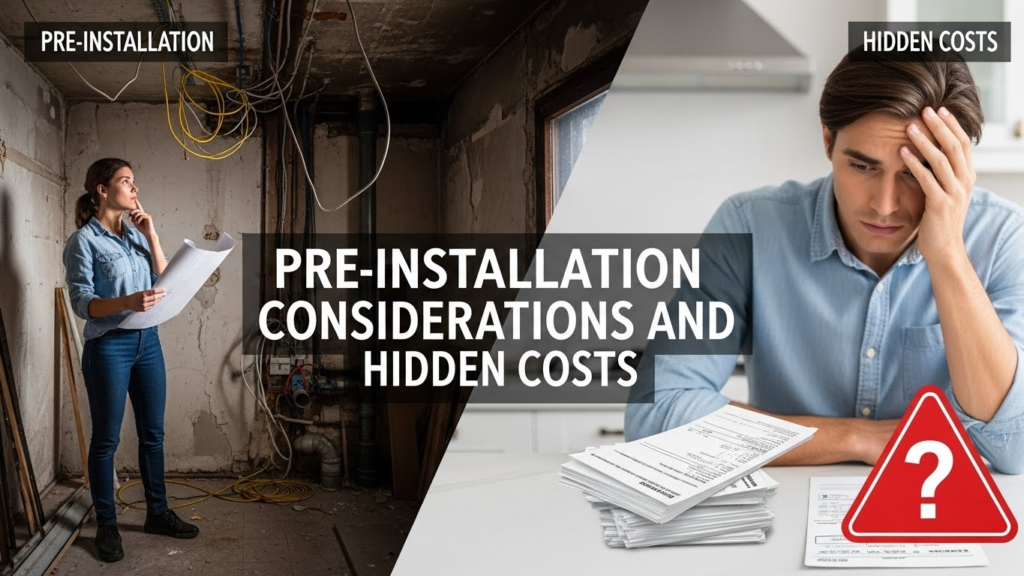
When budgeting for central air installation cost, you must account for the line items that don’t appear in the big flashy advertisements. Contractors will include these in a detailed quote, but they can be a shock if you aren’t expecting them.
Electrical Upgrades
Central AC units require significant power. If you have an older electrical panel (e.g., 100 amps) that is already maxed out by modern appliances, you may need a panel upgrade to 200 amps.
- Estimated Cost: $1,500 – $3,000
Plumbing and Drains
AC units pull humidity out of the air, which turns into water (condensate). This water needs to go somewhere. If you don’t have a nearby drain line, the installer must run new PVC piping or install a condensate pump to push the water to a drain or outside.
- Estimated Cost: $200 – $600
Structural Modifications
If your new indoor unit is larger than the old one, or if you are installing a unit in an attic for the first time, carpenters may need to frame out a platform or widen an attic access door.
- Estimated Cost: $300 – $1,000
Asbestos Removal
If you have an older home (pre-1980s) and need ductwork modification, you might encounter asbestos wrapping on old ducts. An HVAC contractor will not touch this. You will need to hire a specialized abatement team before the AC installation can begin.
- Estimated Cost: $1,500+
Permit Fees
Almost every municipality requires a mechanical permit for HVAC installation to ensure safety codes are met.
- Estimated Cost: $200 – $500 (usually handled by the contractor but billed to you).
Comparing Cooling Options: Is Central Air Right for You?
While central air is the gold standard for home cooling solutions, it isn’t the only option. Depending on your home’s layout, other systems might be more cost-effective.
Central Air vs. Ductless Mini-Splits
If your home lacks ductwork, the cost to retrofit ducts can be prohibitive. Ductless mini-splits are wall-mounted units connected to an outdoor compressor. They require no ducts.
- Cost: $3,000 – $5,000 per zone (room).
- Verdict: If you only need to cool 2-3 rooms, mini-splits are often cheaper and more efficient than installing central air with new ducts. If you need to cool a whole house, central air is usually more cost-effective.
Central Air vs. Heat Pumps
A heat pump looks and acts exactly like a central AC in the summer. The difference is that it can run in reverse to heat your home in the winter.
- Cost: Generally 10-20% more than a standard cooling-only AC.
- Verdict: If your furnace is also old, replacing both with a heat pump system is a brilliant financial move. New federal tax incentives make heat pumps very attractive in 2026.
How to Save Money on Your Installation

You do not have to accept the first high price you see. There are legitimate ways to lower your central air installation cost without sacrificing quality.
1. Leverage the “Shoulder Seasons”
HVAC contractors are swamped in July and freezing in January. During the spring (March/April) and fall (September/October), business slows down. Many companies offer discounts or waived installation fees to keep their crews busy during these months.
2. Hunt for Rebates and Tax Credits
The Inflation Reduction Act (IRA) and various state programs offer money back for high-efficiency systems.
- Federal Tax Credits: You can claim 30% of the project cost, up to $600 for qualified central air conditioners and up to $2,000 for heat pumps.
- Utility Rebates: Local power companies often send checks for $100–$500 if you install Energy Star-rated equipment. Ask your contractor about these; they usually handle the paperwork for you.
3. Get Three Detailed Quotes
Never go with the first bid. Get three quotes from reputable local companies.
- Look at the specific model numbers they are proposing. Is Contractor A cheaper because they are quoting a lower-tier brand or a lower SEER rating?
- Ask about warranties. A labor warranty of 2-5 years can save you thousands in repairs down the road.
4. Keep Your Old Furnace (If Possible)
Some contractors will pressure you to replace your furnace at the same time as the AC. While this ensures compatibility, it isn’t always necessary. If your furnace is less than 10 years old, you can usually just install the AC unit (coil and condenser). This saves you the cost of the heating unit, roughly $2,500 – $4,000.
The Risks of DIY Installation
In an era of YouTube tutorials, you might be tempted to try a DIY approach to save on labor. Do not do this.
Installing central air requires:
- EPA Certification: You legally cannot purchase or handle refrigerant (Freon/Puron) without an EPA Section 608 certification.
- Specialized Tools: You need vacuum pumps, manifold gauges, and torches for brazing copper lines.
- Electrical Knowledge: Wiring a 220-volt condenser incorrectly can cause a fire or electrocution.
Furthermore, almost every manufacturer voids the equipment warranty if the unit is not installed by a licensed professional. Saving $3,000 on labor isn’t worth it if you burn out a $4,000 compressor in a week and have no warranty to cover it.
Conclusion
Installing central air is a major financial decision, but it pays dividends in quality of life. While the average cost hovers around $7,500, your specific price tag depends on your home’s infrastructure and your efficiency goals.
Focus on value rather than just the lowest sticker price. A slightly more expensive, higher-efficiency unit installed by a top-rated contractor will cost you less over 15 years than a cheap unit installed poorly.
Start by checking your ductwork status and your electrical panel. Then, reach out to local pros during the spring or fall to get the best rates. With the right research, you can transform your home into a cool sanctuary without burning through your savings.